.png?width=1024&height=256&name=Aterous%20Logo%20-%20Black%20Transparent%20(1024x256).png)
gtm
abm
strategy

Revenue Strategy · GTM Leadership · Cybersecurity & AI
Why most technical startups are writing the wrong message for the wrong person, and how to find the version that actually closes deals.
GTM Strategy | Messaging · Positioning · Cybersecurity · AI | 9 min read
There is a moment every startup goes through. You've built something genuinely impressive. The engineers are proud of it. The technical champion at your first prospect account has been nodding enthusiastically through every demo. And then someone asks you to present to the budget owner, the executive sponsor, or the VP of Operations, the person actually signing the purchase order, and the room goes quiet in a different way.
Not the good kind of quiet.
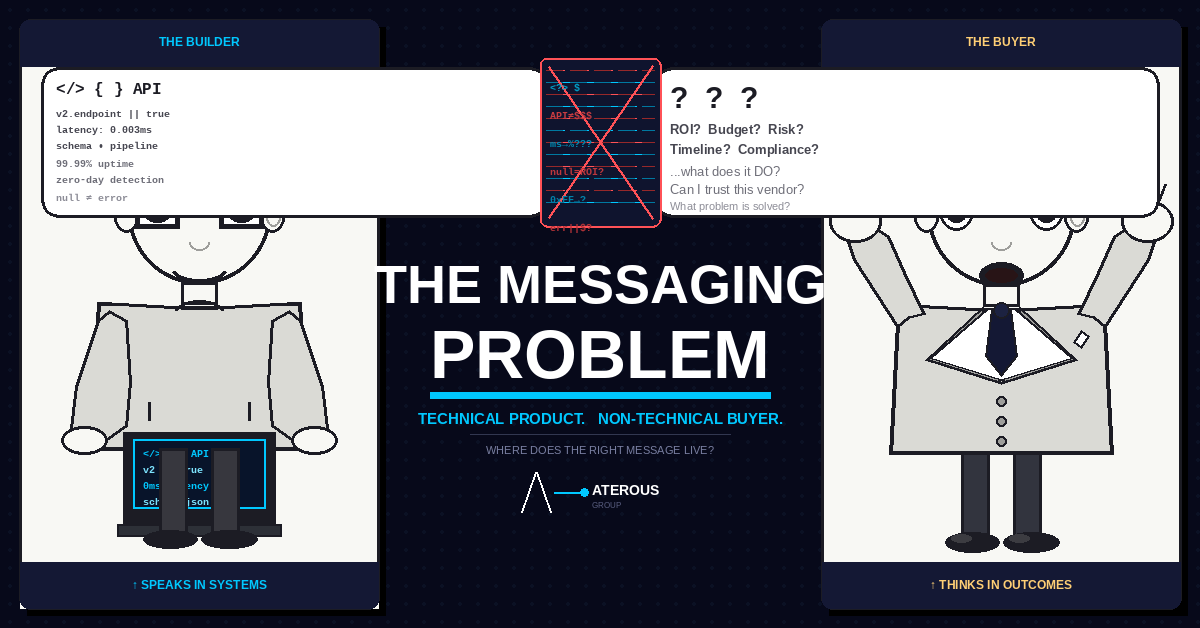
The kind where you realize, halfway through slide three, that the person across the table doesn't care about your architecture. They don't care about your detection fidelity. They aren't impressed by the benchmark comparisons. They're waiting for you to answer a question you haven't asked yourself yet: "What does this mean for my business if I don't buy it?"
That moment, that disconnect, is the messaging problem. And it kills more technically excellent products than bad engineering ever will.
Here's the uncomfortable truth: the problem is almost never the product. It's the message. More specifically, it's a message architected for one person in the buying committee, deployed to all of them, and wondering why it doesn't land.
The Hard Truth
Most startups don't have a messaging problem. They have a choice between two messaging problems, and they pick one without realizing it's still a trap.
Failure Mode One
Over-indexed on Technical Depth
The website reads like a whitepaper. The pitch deck leads with architecture diagrams. The one-pager is 60% acronyms. The sales deck explains how the product works before it ever explains what problem it solves. The technical champion loves it. The economic buyer's eyes glaze over in the first five minutes, and then they delegate the decision back down, which means it either stalls indefinitely or gets decided by someone without budget authority.
Failure Mode Two
Over-indexed on Business Outcomes
In reaction to the above, the pendulum swings. The messaging gets stripped of all technical substance. Everything becomes "reduce risk," "accelerate growth," "drive efficiency." Every startup in every category says the same things. The language is indistinguishable from a competitor two booths over at RSA. The economic buyer nods along but feels no urgency. And the technical champion, the person who will actually live with your product, loses faith before the POC even starts, because nothing in the message reflects that you understand the problem at a working level.
Both failure modes share the same root cause: treating the buying committee as a single person with a single set of needs. They aren't. They never were.
Know Your Room
Enterprise and mid-market deals, especially in cybersecurity and AI, involve five distinct stakeholder types. Each one needs a different message. Ignore any of them and the deal either stalls or dies quietly in a room you were never invited into.
Stakeholder 01
The Technical Champion
Lives with the problem every day. They've felt the pain your product solves. They can evaluate your architecture, interrogate your methodology, and detect when your claims don't hold up under technical pressure. They are your internal advocate, but only if your message earns their trust. If your pitch feels generic, they won't go to bat for you. If it feels over-simplified, they actively lose confidence in you. The technical champion needs enough depth to believe you, enough specificity to defend you, and enough substance to bring their manager along.
Stakeholder 02
The Economic Buyer
Is protecting budget, managing organizational risk, and answering to a board. They are not evaluating your product. They are evaluating whether approving this purchase is defensible, valuable, and safe. They need a business case, not a product pitch. They need to understand what changes if they say yes, and what they're exposed to if they say no. They are almost never in your demos, but they are almost always the reason deals close or die.
Stakeholder 03
The Executive Sponsor
Sits above the buying decision but shapes its direction. This is the C-suite or senior leader whose strategic priorities define whether your category even has a seat at the table this quarter. The mistake most startups make is treating the executive sponsor like a larger version of the economic buyer. They aren't. The economic buyer asks "can we justify this cost?" The executive sponsor asks "does this move the needle on what I've already told the board we're doing?" Your message at this level must connect your solution to their named business priorities, not abstract ROI, but the specific initiatives already in motion. If your product can be positioned as an accelerant to something they're already on the hook to deliver, you aren't selling them something new. You're helping them win something they already started.
Stakeholder 04 ⚠
The Blocker
The persona nobody includes in a buying committee diagram, and the one who quietly kills the most deals. This is typically a technical stakeholder: a senior architect, a security lead, or a long-tenured IT decision-maker who doesn't believe the problem is real, doesn't believe your solution is the right approach, or has a personal or political investment in the status quo. The Blocker rarely announces themselves. They ask pointed technical questions designed to surface gaps. They go quiet after demos rather than engaging. They raise concerns in internal conversations you'll never be party to. Messaging alone doesn't neutralize a Blocker, but the absence of a strong technical layer makes it worse. If your pitch has no substance at the working level, the Blocker has everything they need to dismiss you. If your technical message is credible, specific, and directly addresses the objections most commonly raised in your category, you give your champion the ammunition to carry into rooms you're not in. Know the Blocker's objections before they raise them. Build your technical layer around answering them preemptively.
Stakeholder 05
The Procurement / Legal Stakeholder
Enters late and creates friction. They aren't buyers. They are gatekeepers evaluating risk, compliance, and contractual exposure. Your message doesn't need to sell them. It needs to not alarm them. Clean, straightforward documentation of security posture, data handling, and contractual standards removes the friction before it builds. Think of your compliance collateral as a message layer in its own right: one designed to neutralize concern rather than generate enthusiasm.
The Framework
The instinct most founders have, especially technical ones, is to find the one message that works for everyone. Something high enough level that it lands with the budget owner or executive sponsor, but specific enough that the CISO doesn't roll their eyes. That message doesn't exist.
What exists instead is a layered message architecture: one core narrative with three execution layers, each calibrated for who's in the room. And this architecture isn't built in isolation. It has to be engineered in direct alignment with your ABM strategy.
If you've read our earlier piece on becoming present with your buying group, you know that ABM isn't just a targeting exercise. It's about building familiarity and relevance with every stakeholder in the account before a sales conversation ever starts. The message layers below are the content engine that makes that presence meaningful. Marketing uses them to architect account-level campaigns that speak to each persona with the right signal at the right time. Sales uses them to shift register, moving fluidly between business narrative and technical depth, in the same meeting.
When both motions pull from the same message architecture, the buying committee experiences a coherent, coordinated signal across every touchpoint: your ads, your content, your outbound, your demo. That coherence is what earns trust in complex, multi-stakeholder deals. Without it, you're not running ABM. You're running separate campaigns that happen to target the same account.
This is the one sentence that captures the problem you solve and why it matters now. It doesn't require technical context or business fluency. It's the sentence you say at a dinner table and people understand it. It anchors everything else. For a cybersecurity or AI startup, it's almost always built around a risk, a gap, or a cost that exists whether or not the buyer has articulated it yet. "Most mid-market security teams are flying blind between detection and response, and that window is where breaches happen." That's a core narrative. Every member of the buying committee can receive it: the champion, the economic buyer, the executive sponsor, and even the Blocker can't dismiss the problem statement before they've engaged with it.
This is also the message layer your ABM campaigns lead with at the top of the funnel, the signal that creates the initial recognition and relevance that makes every subsequent touchpoint land harder.
This layer translates the core narrative into financial and operational language. It answers three questions: What does this cost you today? What does it cost you if it gets worse? What does it cost to fix it with us, and what does that investment return? For the economic buyer, this is a business case they can present internally without your help, which means it has to be self-contained, with numbers where possible and risk framing where not. For the executive sponsor, it goes one level higher: this is where you connect your solution to the strategic initiatives already on their roadmap. Don't make them connect the dots. Connect them explicitly.
Your ABM campaigns targeting these personas should be saturated with this layer: executive-level content, ROI frameworks, industry benchmarks, and risk narratives that make the business case feel self-evident before a single sales call happens. When your AE finally gets in the room, they aren't introducing the business case. They're closing it.
This layer restores the credibility the business layer strips out. The technical champion needs to see that you actually understand the problem at the working level: architecture, methodology, integration approach, detection logic, whatever is specific to your category. This is also your primary tool for pre-empting the Blocker. The most effective version of this layer doesn't just explain how your product works. It directly addresses the objections most commonly raised by skeptical technical stakeholders in your space, before those objections are ever voiced.
Your ABM content targeting technical personas should be rich with this layer: technical blogs, architecture deep-dives, integration guides, and benchmark data that give the champion language and the Blocker less ground to stand on. When your AE walks into the technical deep-dive, they aren't introducing these ideas for the first time. They're continuing a conversation the champion has already been having with your content for weeks.
The economic buyer approves the budget. The technical champion approves the vendor.
If your message only lands with one of them, you don't have a sales problem.
You have a messaging architecture problem.
In Practice
The right message doesn't live in the business layer. It doesn't live in the technical layer. It lives in the translation point between them, and that translation is the job of your positioning, your sales team, and your collateral, working in concert.
Your website leads with the business problem and the outcome.
It establishes urgency and relevance for the economic buyer and executive sponsor doing early-stage research. The language is clear, direct, and outcome-oriented, though not vague. Specificity is what separates "reduce your attack surface" (everyone says this) from "give your SOC team the context they need to triage a genuine alert in under four minutes instead of forty" (only you can say this). That specificity is also what your ABM campaigns need to break through at the account level. Generic outcomes are invisible in a crowded category.
Your sales deck opens at the business layer and earns its way into the technical layer.
The first five slides need to confirm to the economic buyer and executive sponsor that you understand their world. The next five need to confirm to the technical champion that you understand theirs. If those audiences are in the room together (and often they are), the structure of the conversation is your message in motion. By the time you get to the technical layer, the business case is already established. By the time you close the business case, the champion already trusts you.
Your technical content lives behind the conversation, not in front of it.
Solution briefs, architecture docs, integration guides: these validate, they don't sell. They are what your champion uses to neutralize the Blocker in the internal conversations you'll never be invited to. In your ABM motion, this content is the late-stage technical nurture that keeps your champion engaged and informed between sales touchpoints.
The failure most startups make isn't in the content itself. It's in the sequencing. Technical content deployed too early signals to the economic buyer that you don't understand what they care about. Business-only content deployed throughout signals to the technical champion that you're either over-simplified or hiding something. Sequence is strategy.
For Pre-Series B Teams
Audit your website as the economic buyer, not the founder.
If the first 200 words on your homepage require technical context to understand, you've already lost the budget owner or executive sponsor before they read a second sentence. Your website is the first message layer your ABM target accounts will encounter. Make sure it's earning the next click, not ending the conversation.
Build two versions of your one-pager.
One for the technical champion: deep, specific, and methodology-forward. One for the economic buyer and executive sponsor: business outcomes, risk framing, ROI indicators, strategic alignment. Stop trying to make one document serve five different people. It serves none of them well.
Train your AEs to read the room, not just run the deck.
The ability to shift register, moving from business narrative to technical depth and back, in a single meeting is a learnable skill. It's also the single biggest differentiator between an AE who closes in complex buying committees and one who doesn't. When marketing has already laid the groundwork through ABM, this job gets easier. The personas have been warmed. The message has been received. Sales is confirming and advancing, not educating from zero.
Let your champion carry the business case.
Your economic buyer and executive sponsor conversations often happen without you in the room. That means your champion needs a business case they can present clearly without technical translation. If you can't give them that, you're asking them to sell something they can't fully explain to the people who control the budget.
Arm your champion against the Blocker before the Blocker speaks.
The most dangerous conversations in a deal happen in rooms you're not in. Your technical content (the architecture docs, the integration guides, the benchmark data) is your proxy in those conversations. If your champion has seen it, internalized it, and can reference it, the Blocker's objections lose their footing before they're ever raised in a formal setting.
Specificity is the antidote to sameness.
Vague outcome language like "improve your security posture" or "accelerate your AI roadmap" is not safe. It's invisible. The startup that can say exactly what changes, for exactly who, in exactly what timeframe, wins the credibility battle before the technical evaluation even starts. That specificity is what your ABM content engine has to be built around. It's what separates a campaign that creates pipeline from one that generates impressions.
⚠ The Trap Nobody Warns You About
There is a meaningful difference between simplification and translation, and your technical champion will know which one you did. If your business-layer message loses all technical credibility in the process of becoming "accessible," you haven't solved the messaging problem. You've traded one failure mode for the other.
The goal is a message that the budget owner or executive sponsor can receive without confusion and the CISO can receive without embarrassment. That's not easy. It requires knowing both worlds well enough to translate between them, not just defaulting to whichever layer feels most comfortable for the founder doing the pitching.
Build both layers. Sequence them deliberately. Never sacrifice one for the other.
The Bottom Line
Technical buyers are not going away. Neither are economic buyers or executive sponsors. And in most enterprise and mid-market B2B transactions, especially in cybersecurity and AI, multiple members of the buying committee will be involved before you're done. The champion who loved your demo, the budget owner who needs a business case, the executive sponsor looking for strategic fit, the Blocker who needs to be out-maneuvered with substance rather than charm. They all need to be spoken to, and they all need to hear something different.
The startups that figure out layered messaging early don't just close faster. They build stronger customer relationships, because both the champion and the executive feel understood from the first interaction. When that's backed by an ABM motion that delivers the right message layer to the right persona before the sales conversation even starts, you aren't just better at messaging. You're running a fundamentally more intelligent go-to-market.
Stop writing one message for a composite buyer that doesn't exist.
Build the architecture. Sequence it deliberately. Let it work across every channel, every persona, every conversation.
That's not a marketing problem. That's your go-to-market foundation.
Questions About Your Messaging Architecture?
Let's talk about how your message lands across the buying committee.
We build the positioning frameworks, message architectures, and GTM programs that cybersecurity and AI startups need to speak credibly to every stakeholder in the room.
Book a Discovery Call.webp?width=1200&height=628&name=aterous-blog--icp-audit%20(1).webp)